The Increasing Globalization of Hockey Talent for Pros and Colleges
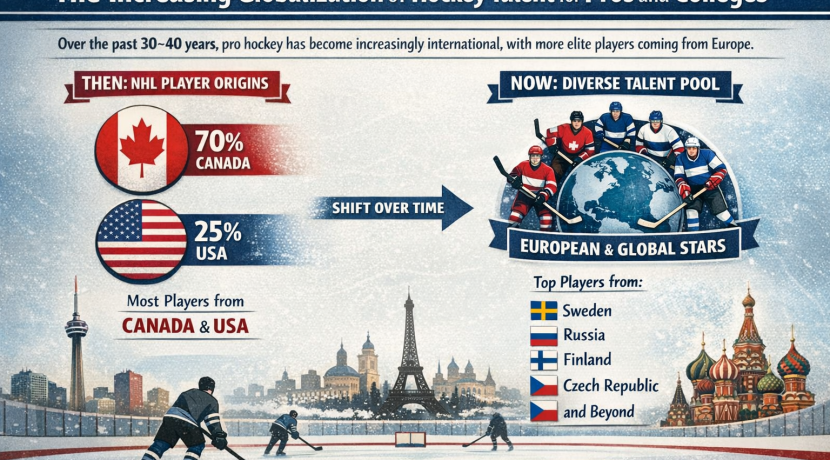
Over the past 30–40 years, professional ice hockey has become increasingly international, with a growing proportion of elite players coming from Europe rather than exclusively from North America. In the early decades of the National Hockey League (NHL), the vast majority of players were Canadian, with a smaller number from the United States. Today, however, European development systems have become major pipelines for professional talent.
Growth of European Hockey Development
Countries such as Sweden, Finland, Russia, the Czech Republic, and Slovakia have built highly structured youth development systems that rival those in North America. These systems emphasize:
-
Early technical skill development
-
Strong national junior leagues
-
Professional club academies
-
International competition at U16, U18, and U20 levels
Players in these countries often grow up in club-based systems, where the same organization trains athletes from childhood through professional levels. This long-term structure produces technically refined players who are well prepared for the modern, fast-paced style of professional hockey.
Changing Composition of Professional Leagues
As a result, the NHL and other professional leagues now include a significant number of European-born players. In many recent NHL seasons, 25–30% of players are from Europe. Sweden and Finland, in particular, produce a large number of highly skilled forwards, defensemen, and goaltenders.
European players are especially known for:
-
Strong skating and puck-handling skills
-
Tactical awareness and positional discipline
-
Development in international tournament environments
These qualities have made European prospects increasingly attractive to scouts and recruiters.
Implications for Global Recruiting
For projects like BrownHockey.tv, this shift has important implications. Talent is no longer concentrated only in traditional North American pipelines such as Canadian junior leagues or U.S. prep schools. Instead, high-level prospects are emerging from dozens of countries, including:
-
Sweden
-
Finland
-
Czech Republic
-
Slovakia
-
Germany
-
Switzerland
-
Kazakhstan
-
Japan
-
Ukraine
Artificial intelligence tools now make it possible to systematically identify players worldwide, analyzing statistics, video, league participation, and development pathways across many countries. This creates an opportunity to discover high-academic, high-potential student-athletes who might otherwise remain invisible to traditional recruiting networks.
The New Global Hockey Landscape
In the modern era, elite hockey talent is truly global. The best players may emerge from Stockholm, Helsinki, Prague, Berlin, or Kyiv just as easily as from Minnesota or Ontario. Programs that understand this global landscape—and use modern tools such as AI-driven scouting—will be best positioned to identify the next generation of scholar-athletes
 Author: jbenet7